
The True Cost of Manufacturing Downtime: Why Your Equipment Partner Matters
When a production line stops unexpectedly, the cost is rarely limited to the machine that failed. Operators may be left waiting, downstream processes can come to a standstill, production schedules can fall behind, and maintenance teams may suddenly be working against the clock to identify a problem and find the parts needed to fix it.
For manufacturers operating high-volume or continuous production environments, even a relatively short interruption can affect an entire operation.
This is why manufacturing downtime should be viewed as more than a maintenance problem. Equipment reliability, preventative maintenance, replacement parts, diagnostics, and technical support all contribute to a manufacturer's ability to maintain production.
It is also why choosing an industrial equipment partner should involve more than comparing machinery specifications and initial purchase prices.
At ESC Induction, we believe manufacturers should consider the entire lifecycle of their equipment. The question is not only how a machine will perform when it is installed, but how it will be maintained, diagnosed, repaired, upgraded, and supported throughout years of production.
What Does Manufacturing Downtime Really Cost?
The financial impact of manufacturing downtime varies significantly depending on the facility, industry, production volume, and process involved. Rather than relying on a single industry-wide estimate, manufacturers should calculate downtime based on their own operation.
The true cost can include several factors:
- Lost production
- Idle operator and production labor
- Maintenance labor
- Scrapped or damaged material
- Missed production targets
- Overtime required to recover lost production
- Expedited replacement parts and shipping
- Delayed customer orders
- Disruptions to upstream and downstream equipment
Some of these costs are immediately visible. Others are more difficult to measure.
For example, if an induction heating system stops in the middle of a production line, the interruption may affect equipment both before and after the heating process. Material may already be staged. Operators may still be scheduled. Downstream machinery may be waiting for parts that are no longer arriving.
The failed component itself might be relatively inexpensive, while the production interruption surrounding it becomes considerably more costly.
Calculate Downtime Based on the Complete Production Process
A useful downtime calculation should look beyond the hourly output of a single machine.
Manufacturers should consider questions such as:
- How many parts should this line produce per hour?
- What is the value of that production?
- How many employees are affected when the line stops?
- Does the failure interrupt other manufacturing processes?
- Can production be moved to another machine?
- Will material need to be scrapped or reprocessed?
- Will overtime be required to recover the production schedule?
- Could the interruption affect customer delivery dates?
Understanding these factors helps put equipment reliability into financial terms.
It can also change the way companies evaluate preventative maintenance and spare parts. A component that seems expensive to keep on the shelf may look very different when compared with the potential cost of waiting several days for that same component while a production line is down.
Why Aging Manufacturing Equipment Can Increase Downtime Risk
Older equipment is not automatically unreliable. Many industrial machines remain productive for decades when they are properly designed, maintained, and updated.
The challenge is that certain components become increasingly difficult to support as equipment ages.
Older PLCs, electronic controls, sensors, drives, power components, and proprietary control boards may eventually become obsolete. Manufacturers may discover that a component they have relied on for years is no longer readily available when it finally fails.
Mechanical wear can create additional problems. Cooling systems can lose performance, electrical connections can deteriorate, induction coils can become damaged, and years of modifications can make troubleshooting more complicated.
Manufacturers operating aging production machinery should periodically evaluate:
- Which components are approaching the end of their expected service life
- Which replacement parts have become obsolete
- Which critical spares should be kept on site
- Whether controls should be modernized before failure
- Whether the original equipment manufacturer can still support the system
- Whether documentation accurately reflects the machine's current configuration
Proactive equipment upgrades can often be scheduled around planned production outages. Emergency modernization is much more difficult when the line has already stopped.
Preventative Maintenance Is About More Than Avoiding Failure
Preventative maintenance is sometimes treated as a checklist: inspect the machine, replace a few components, and return it to service.
A strong preventative maintenance program should go further.
The objective is to identify changes in equipment condition before those changes become production problems.
For industrial induction heating equipment, preventative maintenance may include inspecting coils, electrical connections, cooling circuits, hoses, power components, control systems, safety devices, and other components critical to reliable operation.
Technicians may also identify problems that are not yet causing a shutdown but could eventually affect performance.
A cooling restriction, for example, may not immediately stop an induction system. Over time, however, inadequate cooling can contribute to excessive temperatures and unnecessary stress on components. Similarly, a damaged coil or deteriorating electrical connection may continue operating while gradually becoming less reliable.
Finding these conditions during scheduled maintenance gives manufacturers more control over when repairs occur.
Remote Diagnostics Can Shorten the Troubleshooting Process
When equipment does stop, one of the first challenges is determining why.
Modern industrial controls can provide valuable information through alarms, operating data, PLC diagnostics, and system status information. When equipment is designed to support remote troubleshooting, an experienced technician may be able to review this information without immediately traveling to the facility.
Remote diagnostics cannot solve every equipment problem, but they can help narrow down the cause of a failure and determine the appropriate next step.
A technician may be able to identify whether the issue involves a sensor, control signal, cooling condition, electrical component, or another part of the system. That information can help determine whether the manufacturer's maintenance team can resolve the issue internally, whether a replacement part is needed, or whether an on-site service visit is necessary.
The faster a manufacturer can move from "the machine is down" to understanding what actually happened, the sooner the team can begin working toward a solution.
Replacement Parts Strategy Matters
Fast technical support provides limited value if the component required to complete a repair is unavailable.
Manufacturers should therefore discuss replacement parts and long-term component availability when purchasing new industrial machinery.
Questions worth asking include:
- Which components are considered critical spares?
- Which parts should be stocked at the facility?
- Are common components readily available?
- Does the equipment rely heavily on proprietary parts?
- What happens if a control component becomes obsolete?
- Can the equipment manufacturer provide replacement components directly?
This conversation should happen before an emergency.
Having a documented spare parts strategy can significantly simplify troubleshooting and repair when equipment eventually requires attention. It also helps maintenance teams understand which components represent the greatest production risk.
Ultimately, minimizing manufacturing downtime requires more than reliable machinery. It requires planning for how that machinery will be supported throughout its working life.
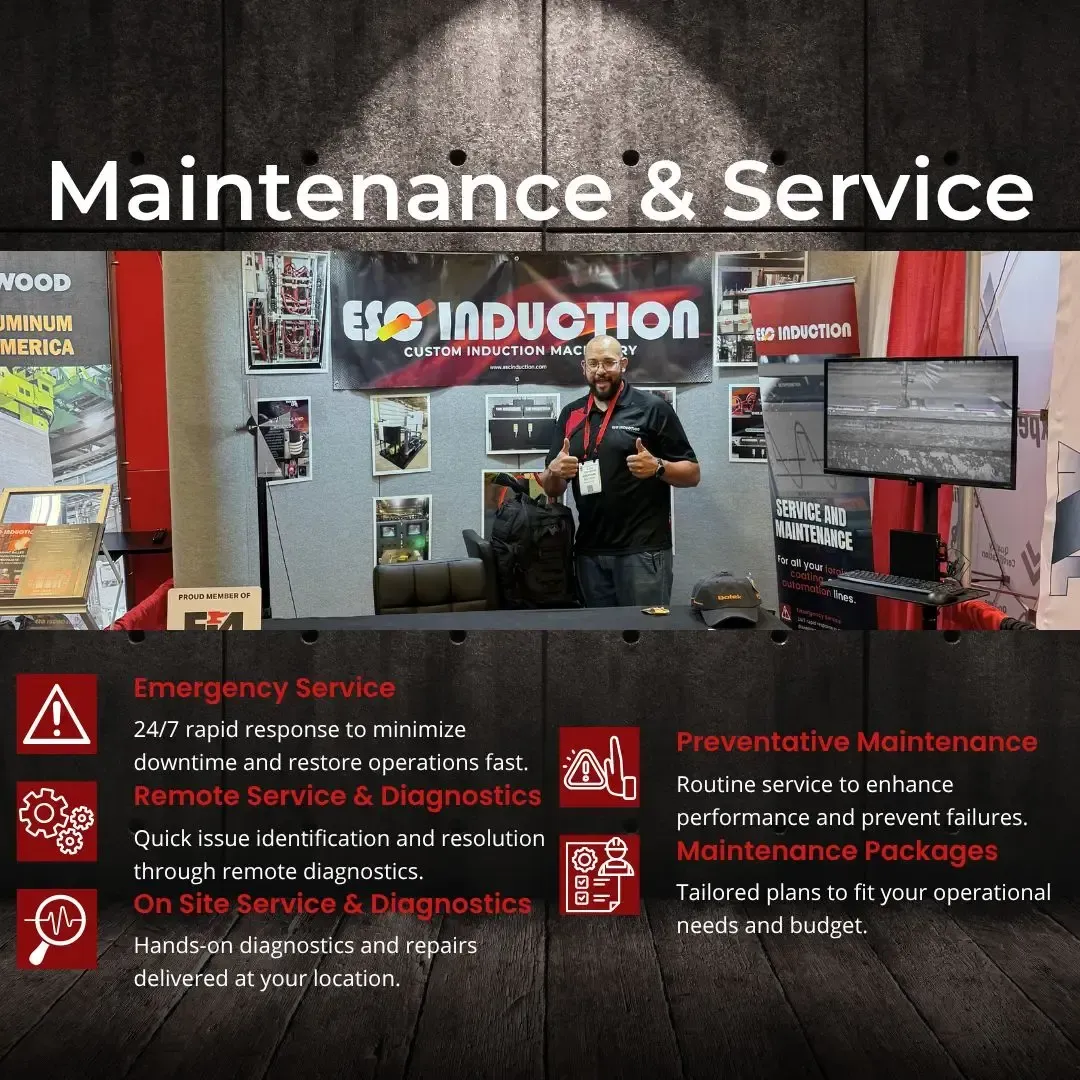
Emergency Service Is Only One Part of Equipment Support
Emergency service matters when production is down, but the strongest equipment support relationships begin long before an emergency occurs.
A manufacturer and equipment partner should already understand the machinery, controls, critical components, and production requirements before a major problem develops. That familiarity can make troubleshooting more efficient because the service team is not starting from the beginning every time support is needed.
Long-term industrial equipment support can include:
- Preventative maintenance
- Remote technical support and diagnostics
- On-site troubleshooting and repair
- Replacement parts
- Control system upgrades
- Induction coil repair and replacement
- Cooling system maintenance
- Equipment modifications
- Automation upgrades
- Planning for obsolete components
The goal is not simply to repair equipment after it fails. The goal is to create a support strategy that helps manufacturers keep critical machinery operating reliably throughout its service life.
Serviceability Should Begin With Equipment Design
The ability to maintain industrial machinery is influenced by decisions made before the machine ever reaches the production floor.
When custom manufacturing equipment is being engineered, serviceability should be part of the design process.
Are critical components accessible? Are electrical panels organized and documented? Can commonly replaced components be changed without extensive machine disassembly? Are operators provided with useful alarms and diagnostics? Are replacement parts available? Can the system be updated as technology changes?
These considerations can have a direct impact on future downtime.
A machine may perform exactly as intended when it is new, but industrial equipment operates in demanding environments for years. Components eventually wear. Production requirements change. Controls become outdated. Maintenance teams change.
Designing equipment with those realities in mind can make long-term ownership significantly easier.
Your Equipment Partner Should Understand the Production Process
Industrial service becomes more effective when the equipment provider understands more than an individual machine.
Consider an induction heating system integrated into a larger automated production line. If the system stops, the problem may not necessarily originate with the induction power supply or coil. The issue could involve material handling, a sensor, cooling, PLC communication, an upstream process, or another component within the production sequence.
A technician who understands how these systems interact can approach troubleshooting differently than someone looking only at one isolated component.
This is particularly important as manufacturing lines become increasingly integrated. Induction heating equipment may operate alongside conveyors, robotics, cooling systems, inspection equipment, presses, coating equipment, and other machinery.
The more connected the process becomes, the more valuable it is to have an equipment partner capable of looking at the complete application.
Plan Maintenance Around Production Instead of Production Around Repairs
Unplanned downtime forces manufacturers to react. Planned maintenance gives them more control.
Whenever possible, inspections, repairs, component replacements, and upgrades should be coordinated with scheduled production outages. This allows maintenance teams to address known issues without waiting for equipment to fail during an active production run.
Manufacturers can work with their equipment partner to establish a maintenance schedule based on factors such as:
- Equipment operating hours
- Production volume
- Application demands
- Component wear
- Cooling system condition
- Coil condition
- Previous maintenance findings
- Manufacturer recommendations
Maintenance intervals should reflect the actual application. Equipment operating multiple shifts in a demanding environment may require a different maintenance strategy than equipment used periodically.
Keeping service records can also help manufacturers identify recurring issues and understand how equipment condition changes over time.
Do Not Wait for Obsolete Components to Become an Emergency
Obsolescence is one of the most important long-term considerations for older manufacturing machinery.
A production line can remain mechanically sound while the electronics controlling it become increasingly difficult to support. PLCs, drives, operator interfaces, sensors, circuit boards, and other electrical components may eventually be discontinued by their original manufacturers.
Waiting until an obsolete component fails can turn a manageable modernization project into an urgent production problem.
Instead, manufacturers should periodically review older equipment and identify components that may create future support challenges. Controls can then be upgraded during planned downtime rather than after a failure.
This approach can also create opportunities to improve the machine. A control modernization project may provide better diagnostics, updated operator interfaces, improved process monitoring, remote support capabilities, or greater flexibility for future automation.
Equipment Upgrades Can Extend the Life of a Production Line
Not every reliability problem requires new machinery.
In many cases, targeted equipment upgrades can extend the useful life of an existing production system while addressing the components creating the greatest operational risk.
An older induction heating system, for example, may benefit from updated controls, repaired or redesigned coils, improved cooling, replacement electronics, or changes to material handling.
Manufacturers may also choose to add automation to an existing process to improve consistency or reduce repetitive manual handling.
The decision should be based on the condition of the equipment and the needs of the production process.
If the underlying machinery remains reliable and capable of meeting production requirements, modernization may provide a practical alternative to complete replacement. If failures are becoming widespread or the system can no longer support production goals, replacement may offer better long-term value.
What to Look for in a Long-Term Industrial Equipment Partner
Manufacturers evaluating new equipment often spend significant time comparing machine capabilities. The same level of attention should be given to the company that will stand behind the equipment.
Before selecting an industrial machinery manufacturer or service provider, ask questions about what happens after installation.
- Does the company provide ongoing technical support?
- Can technicians troubleshoot equipment remotely?
- Is on-site industrial service available?
- Does the company provide preventative maintenance?
- Can it supply replacement parts?
- Can older equipment be upgraded or modified?
- Does the company understand controls, automation, cooling, and material handling?
- Can it support custom equipment rather than only standard machinery?
- Will the same partner be able to help as production requirements change?
These questions can reveal an important difference between purchasing a machine and establishing a long-term equipment relationship.
Reliable Production Requires a Long-Term Strategy
There is no way to eliminate every unexpected equipment problem. Manufacturing machinery operates under real production conditions, and components eventually require maintenance, repair, or replacement.
What manufacturers can control is how prepared they are when those situations occur.
A strong reliability strategy combines well-engineered equipment with preventative maintenance, accessible replacement parts, knowledgeable technical support, remote diagnostics, planned modernization, and a clear understanding of which systems are most critical to production.
It also requires an equipment partner that understands what downtime means to a manufacturing operation.
Keeping Production Running With ESC Induction
At ESC Induction, our relationship with a customer does not end when equipment leaves our facility.
We engineer custom induction heating systems and industrial machinery with long-term operation in mind, while also providing the services manufacturers need to support equipment already on the production floor.
Our capabilities include custom induction heating systems, automation, custom coils, cooling systems, control systems, preventative maintenance, replacement parts, remote technical support, on-site diagnostics, emergency service, and equipment upgrades.
Because our team works across engineering, controls, heating, cooling, automation, and service, we can evaluate how individual components affect the larger manufacturing process.
Whether you are planning new manufacturing equipment, modernizing an aging production line, or looking for a partner to help support existing induction equipment, the objective is the same: keep production reliable and minimize the disruptions that cost your operation time.
Your production equipment should be supported for the long haul.
Contact ESC Induction to discuss your induction heating equipment, preventative maintenance needs, production line upgrades, or long-term industrial service strategy.


