How to Build a Production Line for the Next 10 Years: Automation, Reliability, and Long-Term Support
Industrial machinery is a long-term investment. A production system installed today may still be heating parts, moving material, and supporting daily manufacturing operations a decade or more from now.
That makes one question particularly important when manufacturers invest in new equipment: will this production line still meet our needs years from now?
No manufacturer can predict every change in products, production volumes, technology, or customer demand. However, equipment can be engineered to make future changes easier to accommodate.
Automation, accessible controls, serviceable components, reliable cooling, preventative maintenance, replacement parts, and long-term technical support all contribute to the useful life of industrial machinery.
At ESC Induction, we believe manufacturers should look beyond what a machine needs to accomplish on its first day of production. Custom industrial equipment should be engineered around today's process while considering how that process may evolve over time.
Start With the Manufacturing Process, Not the Equipment
Planning a production line for long-term performance begins with understanding the manufacturing process itself.
Before designing machinery, manufacturers and equipment engineers should identify what the operation needs to accomplish. That includes current requirements as well as reasonable expectations for future production.
Important questions include:
- What parts will the equipment process?
- What production rate is required?
- Could production volumes increase?
- Could additional part sizes or products be introduced?
- What heating or processing requirements must be maintained?
- How will material enter and leave the system?
- What equipment exists upstream and downstream?
- What level of operator involvement is required?
- Could additional automation be added later?
- How will the equipment be maintained?
These questions help define more than the immediate equipment specification. They provide a framework for building a production system that can continue supporting the operation as manufacturing requirements change.
Build Flexibility Into Custom Industrial Machinery
Flexibility does not mean designing machinery for every possible future scenario. That can add unnecessary complexity and cost.
Instead, manufacturers should identify which changes are reasonably likely and determine whether the equipment can accommodate them.
For example, a manufacturer may anticipate producing additional part sizes in the future. A custom induction heating system could be designed with programmable heating recipes or interchangeable tooling that makes those changes easier to manage.
Likewise, a production line that begins with manual material loading may be designed so robotic handling or additional automation can be integrated later.
Other ways to support future flexibility can include:
- Programmable PLC controls
- Recipe-based production settings
- Modular machine layouts
- Accessible electrical systems
- Adaptable material handling
- Replaceable tooling and induction coils
- Expandable automation
- Controls capable of communicating with other plant equipment
The goal is not to overengineer the machine. It is to avoid design decisions that unnecessarily limit the manufacturer's options later.
Automation Should Solve a Production Problem
Automation is becoming an increasingly important part of modern manufacturing, but automation itself should not be the objective.
The objective should be better production.
Manufacturers may introduce automation to improve throughput, reduce repetitive manual handling, create more consistent cycle times, improve operator safety, or coordinate multiple pieces of industrial equipment.
A custom automation system may include:
- Robotic material handling
- Conveyors
- Indexing systems
- Automated loading and unloading
- Part positioning
- PLC controls
- Touchscreen operator interfaces
- Process monitoring
- Temperature monitoring
- Safety interlocks
When automation is designed around the manufacturing process, it can improve consistency while creating a more coordinated production line.
It can also provide a foundation for future expansion. Manufacturers that anticipate additional automation should discuss those plans during the original equipment design process, even if the additional systems will not be installed immediately.
Controls Should Help Operators and Maintenance Teams
Modern controls do much more than turn industrial machinery on and off.
PLC systems, operator interfaces, sensors, alarms, and process monitoring can provide information that helps production teams operate equipment consistently and helps maintenance teams understand what is happening when a problem occurs.
A well-designed control system may provide:
- Production recipes
- Temperature settings
- Machine status information
- Alarm history
- Diagnostic information
- Process monitoring
- Maintenance reminders
- Remote troubleshooting capabilities
These features become increasingly valuable as equipment ages.
Ten years after installation, the technician troubleshooting the machine may not be the person who originally installed it. Clear controls, useful diagnostics, organized electrical panels, and accurate documentation can make understanding the system significantly easier.
Plan for Controls and Component Obsolescence
Mechanical equipment can remain productive for decades, but electronic technology often changes much faster.
A PLC, drive, touchscreen, sensor, or control component available today may eventually be replaced by a newer product generation or discontinued entirely.
That does not mean manufacturers should avoid modern electronics. It means equipment should be designed with future serviceability in mind.
Manufacturers should discuss component selection with their industrial machinery partner and understand which components are standard, which are specialized, and how future replacements or upgrades can be handled.
Equipment documentation should also be maintained throughout the life of the machine. If controls or electrical components are changed, drawings and records should reflect those modifications.
Planning for obsolescence is much easier than discovering during an unexpected shutdown that a critical component is no longer readily available.
Cooling Is Part of Long-Term Equipment Reliability
For induction heating equipment, the heating process receives much of the attention. Reliable cooling is just as important to the long-term performance of the system.
Induction coils, power supplies, transformers, and other components can depend on controlled water flow and temperature to operate correctly.
A cooling system should therefore be engineered around the demands of the application rather than treated as an accessory added after the primary equipment has been selected.
Factors such as water flow, pressure, temperature, water quality, heat load, and system capacity all need to be considered.
Manufacturers should also consider future production requirements. If equipment is expected to operate longer shifts or support additional heating capacity later, the cooling system needs to be evaluated as part of that plan.
Design for the Technician Who Will Eventually Service the Machine
Serviceability is one of the easiest considerations to overlook when designing new industrial machinery.
When equipment is new, the focus is naturally on performance. Eventually, however, components will need inspection, maintenance, repair, or replacement.
Good industrial machinery design should provide reasonable access to the components technicians are most likely to service.
Electrical panels should be organized. Connections should be documented. Wear components should be accessible. Cooling circuits should be inspectable. Controls should provide useful diagnostic information.
These details may not make a machine look more impressive on installation day, but they can make a significant difference throughout years of production.
Long-term reliability begins with equipment that is not only engineered to run, but engineered to be maintained.
Preventative Maintenance Should Be Part of the Long-Term Plan
Even well-engineered industrial machinery requires maintenance. The difference is whether maintenance is planned around production or forced into the schedule after something fails.
A preventative maintenance strategy gives manufacturers an opportunity to inspect critical systems, identify developing problems, replace worn components, and schedule repairs before they result in unexpected production interruptions.
For induction heating and automated manufacturing equipment, preventative maintenance may include:
- Inspecting induction coils
- Checking electrical connections
- Evaluating cooling system performance
- Inspecting hoses and water circuits
- Reviewing alarms and control system operation
- Testing safety devices and interlocks
- Inspecting material handling equipment
- Checking sensors and positioning systems
- Reviewing wear components
- Identifying components approaching obsolescence
Maintenance requirements should reflect the actual application. A system operating continuously in a demanding production environment may require a different service schedule than equipment operating intermittently.
Keeping accurate maintenance records can also help manufacturers identify patterns over time. Recurring issues may indicate that a component needs to be redesigned, upgraded, or replaced rather than repeatedly repaired.
Think About Replacement Parts Before Production Depends on Them
A production line designed for long-term reliability should also have a replacement parts strategy.
Manufacturers should identify which components are critical to production and determine whether those parts should be kept on site. The right spare parts inventory will vary by machine, but the decision should consider component availability, lead time, likelihood of failure, and the production impact if the component is unavailable.
Questions to discuss with an equipment partner include:
- Which components are considered critical spares?
- Which parts have longer replacement lead times?
- Are commonly replaced components readily available?
- Which components are unique to the equipment?
- Can replacement parts be supplied directly by the equipment manufacturer?
- What is the plan if an electronic component becomes obsolete?
A relatively small component can create a significant production interruption if a replacement cannot be sourced quickly.
Planning for replacement parts when equipment is commissioned gives maintenance teams a clearer path forward when repairs are eventually required.
Remote Diagnostics Can Support Faster Troubleshooting
Another consideration for long-term production equipment is how the system will be diagnosed when a problem occurs.
Modern control systems can provide technicians with valuable information about machine status, alarms, sensors, temperatures, operating sequences, and other conditions. When remote diagnostic capabilities are incorporated into the system, an equipment partner may be able to use that information to assist the manufacturer's maintenance team without immediately traveling to the facility.
Remote support will not replace every on-site service visit, but it can provide an important first step in troubleshooting.
A technician may be able to determine whether an issue involves a control signal, sensor, cooling condition, electrical component, automation sequence, or another part of the process. That information can help identify what should happen next.
For manufacturers operating equipment across multiple shifts or at facilities located far from the original equipment manufacturer, access to knowledgeable technical support can become an important part of a long-term reliability strategy.
Plan for Equipment Upgrades Instead of Waiting for a Complete Replacement
A production line designed for the next decade should not require complete replacement every time technology or production requirements change.
In many cases, targeted upgrades can extend equipment life while improving performance.
Future upgrades might include:
- New PLC controls
- Updated touchscreen interfaces
- Additional sensors
- Remote diagnostic capabilities
- New induction coil designs
- Cooling system improvements
- Additional automation
- Robotic material handling
- Updated safety systems
- Changes for new part sizes or production requirements
Thinking about upgradeability during the original design process can make these modifications easier to accomplish later.
This is especially valuable when the mechanical portion of a machine remains in good condition. Rather than replacing productive equipment because one area has become outdated, manufacturers may be able to modernize specific systems and continue using the existing machinery.
Production Reliability Depends on More Than the Machine
Long-term reliability is not created by a single component.
The induction heating system may be performing correctly, but inadequate cooling can still cause problems. A heating process may be fast and consistent, but poorly coordinated material handling can create a bottleneck. Reliable mechanical equipment can still experience unnecessary downtime if controls are difficult to diagnose or replacement components are unavailable.
This is why production equipment should be evaluated as a complete system.
Heating, cooling, controls, automation, material handling, electrical systems, maintenance access, replacement parts, and technical support all contribute to the reliability of a production line.
When these elements are engineered together, manufacturers are better positioned to maintain consistent production and adapt the system as requirements change.
Choose an Equipment Partner That Can Support the Entire Lifecycle
One of the most important decisions manufacturers make may not be which individual components go into a machine. It may be choosing the company that will support the equipment throughout its working life.
A custom industrial machinery partner should be capable of helping during engineering and installation, but manufacturers should also ask what happens several years later.
Can the company provide replacement parts? Can it troubleshoot controls? Does it provide preventative maintenance? Can technicians assist remotely? Is on-site service available? Can the company modify the equipment when production requirements change?
These capabilities become increasingly important as machinery ages.
An equipment partner that understands the original application can also provide valuable context when modifications are needed. Instead of approaching the machine as an unfamiliar system, the team can understand why it was designed a certain way and how proposed changes may affect the larger production process.
Documentation and Training Support Long-Term Reliability
People change throughout the life of industrial machinery. Operators move into new roles. Maintenance personnel retire. Engineers join the company years after equipment was originally installed.
That makes good equipment documentation and training an important part of long-term reliability.
Manufacturers should receive appropriate information for operating, maintaining, and troubleshooting their equipment. Depending on the system, documentation may include electrical drawings, component information, maintenance recommendations, operating procedures, controls information, and replacement parts documentation.
Training helps the people working with the machine understand how the system is intended to operate and what to watch for during normal production.
Documentation should also evolve with the equipment. If a production line is modified or controls are upgraded, records should be updated so future technicians are not troubleshooting a machine that no longer matches its original drawings.
Prepare for Production Requirements to Change
The production requirements a manufacturer has today may look very different several years from now.
Customers may require new products. Production volumes may increase. New materials may be introduced. Additional automation may become practical. A manufacturer may need greater process visibility or different quality controls.
Equipment cannot be designed for every unknown possibility, but manufacturers can avoid unnecessarily limiting future options.
When planning custom machinery, discuss foreseeable changes with the engineering team. Even if additional capabilities are not included in the initial project, knowing that they may be required later can influence decisions involving controls, floor space, electrical capacity, cooling, machine layout, and material handling.
A little planning during the initial design process can make future expansion considerably easier.
Build for More Than Installation Day
New industrial machinery naturally receives the most attention during design, installation, and startup. The real measure of the equipment, however, comes during the years of production that follow.
Will it remain reliable? Can maintenance teams work on it efficiently? Can replacement parts be sourced? Can controls be updated? Can the equipment adapt when production requirements change? Is knowledgeable technical support available when something unexpected happens?
Those questions should be considered before the machine is built.
At ESC Induction, we engineer custom induction heating systems and industrial machinery around the manufacturing process, while also considering what will be required to support that equipment over the long term.
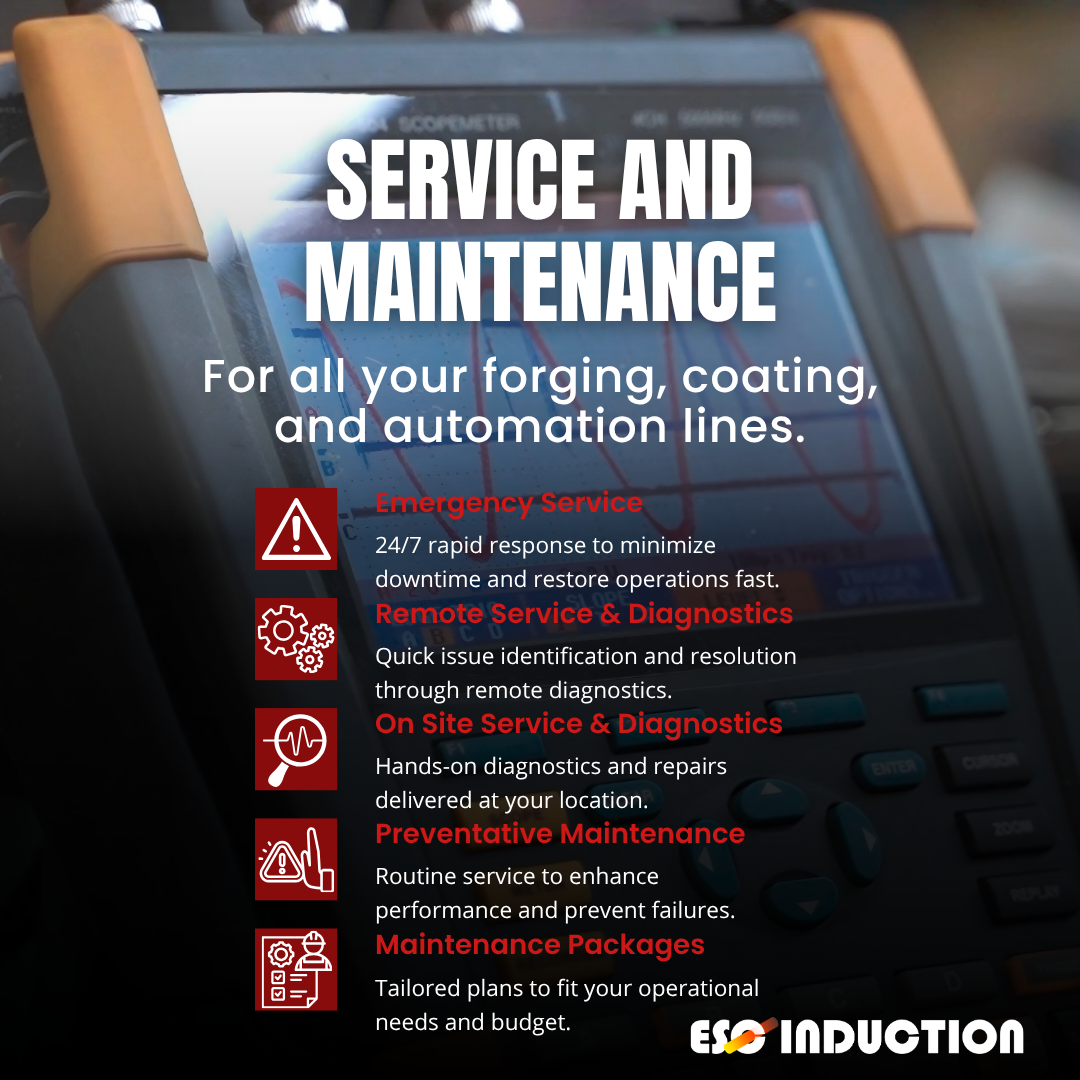
Our capabilities include custom induction heating systems, automation, PLC integration, robotic material handling, custom induction coils, cooling systems, preventative maintenance, replacement parts, remote technical support, on-site diagnostics, emergency service, and equipment upgrades.
That combination allows our team to look at the complete production system rather than a single piece of machinery.
The goal is not simply to build equipment that works today. It is to engineer a production solution that manufacturers can operate, maintain, support, and adapt for years to come.
If you are planning a new production line, replacing aging manufacturing equipment, adding automation, or preparing an existing process for future growth, contact ESC Induction to discuss your application and long-term production goals.